

How much you know about money and how confident you feel about it are two different things, and the gap between them shapes almost every financial decision you make.
Some of the costliest mistakes we see don't come from a lack of information. They come from feeling more certain than the situation deserves, or less certain than it does. Knowing where you stand on that spectrum is one of the most useful things you can learn about yourself as an investor. It also tells you what kind of help will serve you best.
The confidence curve
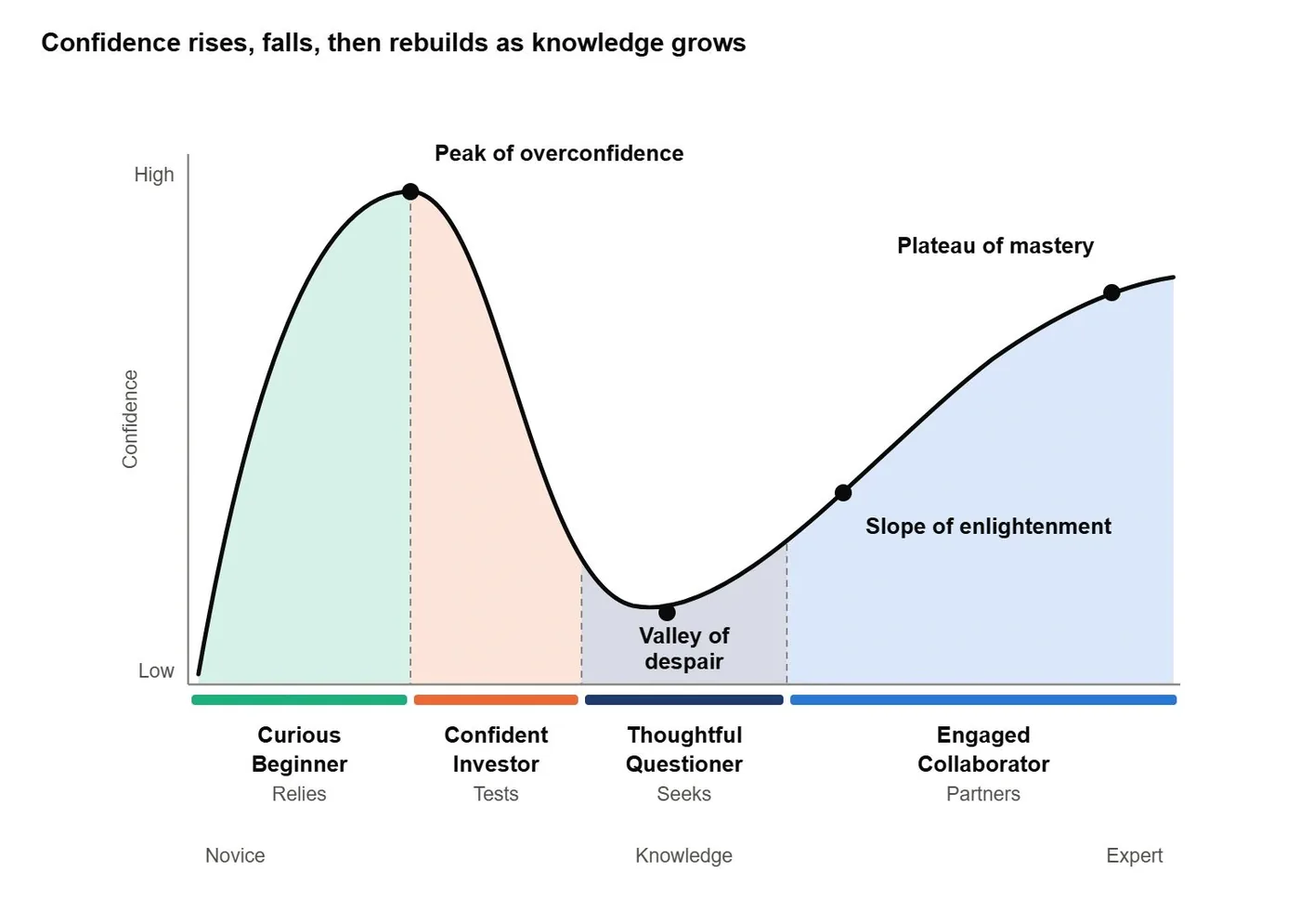
In 1999, psychologists David Dunning and Justin Kruger found that people with the least skill in an area tended to overestimate their ability most, while the most skilled slightly underestimated theirs. That finding is now popularly drawn as a curve of confidence against knowledge, and it maps neatly onto how people handle their finances.
As knowledge grows, confidence typically spikes early, drops sharply once the real complexity becomes clear, and then rebuilds slowly into something steadier and better grounded. Along the way, most investors fall into one of four broad groups. None is better or worse than another; each simply needs something different from an advisor.
Each group works with advice in its own way. The Curious Beginner relies on guidance, the Confident Investor tests ideas, the Thoughtful Questioner seeks structure, and the Engaged Collaborator partners as a peer.
The Curious Beginner
You may be early in your career, newly responsible for family finances, or managing an inheritance or a life change for the first time. You know there's a lot you don't know, and you're open about it. The biggest risk at this stage isn't a bad decision so much as no decision: cash left idle, an employer match left on the table, or trusting whoever sounds most certain.
How an advisor helps. A fiduciary advisor is required to put your interests first, which matters most when you're least able to judge a sales pitch. A good first step is a plan that covers the foundations: an emergency fund, debt, insurance, workplace benefits, and beneficiary designations. From there, a simple, diversified portfolio can do the work without you needing to master every detail.
What to expect. Conversations should start with your goals, not with markets or products. Expect plain language, one idea at a time, and clear answers about how your advisor is paid. A good advisor also helps you understand your own plan, so your confidence grows on solid ground.
The Confident Investor
You read the financial news, pick your own investments, and may have done well doing it. You probably don't feel you need an advisor, and that's a reasonable starting point. The risks here are quieter: a portfolio concentrated in a few familiar names, trading that adds up in taxes, or a plan that covers investments well but leaves estate documents, insurance, or tax planning untouched.
How an advisor helps. You don't need someone to take over. You may benefit from a second opinion: an independent stress test of your portfolio, a look at how it would behave in a severe downturn, and a review of the areas outside investing that are easy to overlook. A guardrail against one large, avoidable mistake can be worth more than any single good pick.
What to expect. A good advisor will respect what you already know and act as a sparring partner, not a lecturer. Many offer project-based reviews instead of full management. Some clients like a split arrangement, where the advisor manages a diversified core and you keep a portion to manage yourself.
The Thoughtful Questioner
Something changed your view. Maybe a market drop, an investment that didn't work out, or a life event made it clear how many moving parts there are. You know a good deal, and you've also seen how much you don't know. That can feel unsettling, but it's often the moment people are most ready to make real progress.
How an advisor helps. This is where structure helps most. An advisor can turn scattered knowledge into one coherent plan, with a written investment policy that connects your portfolio to your goals. Just as important is helping a recent setback stay a lesson rather than turn into an overcorrection, such as moving everything to cash at the wrong time.
What to expect. Bring your questions; a good advisor welcomes them and shows their reasoning. Expect clear rules written down in advance, such as when the portfolio is rebalanced and what happens in a downturn. Many people find it calming to divide money into time-based buckets, so short-term needs are protected from long-term market swings.
The Engaged Collaborator
You have deep knowledge and a realistic sense of its limits. You may own a business, hold equity compensation, or have worked in finance yourself. You won't hand over control blindly, but you value expertise, your own time, and an objective view on decisions that are close to home.
How an advisor helps. At this level, the value is in depth and coordination: rigorous investment analysis, planning for business succession, stock options, charitable giving, and multigenerational estates, and working alongside your CPA and attorney so nothing falls between them. An advisor can also give you time back by carrying out work you could do but would rather not.
What to expect. A peer-level relationship. A good advisor shares the research and reasoning, lays out options with their trade-offs, and decides with you. Expect them to bring ideas to you before you ask, and to be specific about the value they provide for the fee.
Why credentials and independence matter
Wherever you are on the curve, the kind of advisor you choose makes a difference. A CFA® charterholder has completed rigorous training in investment analysis and portfolio management. A CERTIFIED FINANCIAL PLANNER® professional is trained across the full range of planning: taxes, retirement, insurance, estate, and cash flow. An independent fiduciary is obligated to act in your best interest, without incentives tied to selling particular products.
The common thread is that a good advisor adapts to you. A Curious Beginner relies on a patient teacher. A Confident Investor tests ideas against a candid sparring partner. A Thoughtful Questioner seeks a steady coach. An Engaged Collaborator partners with an advisor as a peer. The goal in every case is the same: knowledge that keeps growing, and confidence that rests on it.
Not sure where you fit? Most people recognize themselves in one of these groups, and many have moved between them over time. We'd welcome a conversation about where you are today and what kind of help would serve you best.
Important Information
Investment advisory services are offered through Gwynedd Wealth Partners, LLC (GWP). Registered Investment Advisor registered in the states of Pennsylvania and Colorado. Nothing in this article is intended to recommend any specific security or investment strategy. Our advisory services are offered only to clients with whom we have an advisory agreement and about whom we have gathered sufficient data concerning their personal objectives, needs, risk tolerance, and circumstances.
Content in this article may include views that consider legal concepts and general taxation principles; however, we do not provide, and are not qualified to provide, anyone with legal or tax advice. We encourage readers to consult with their own attorney or tax professional to receive advice and guidance about their specific circumstances.
CFA®, Chartered Financial Analyst®, and CIPM® are registered trademarks owned by CFA Institute.
Certified Financial Planner Board of Standards Center for Financial Planning, Inc. owns and licenses the certification marks CFP® and CERTIFIED FINANCIAL PLANNER® in the United States to Certified Financial Planner Board of Standards, Inc., which authorizes individuals who successfully complete the organization's initial and ongoing certification requirements to use the certification marks.
This article is general information, not personalized advice. Investment advisory services are offered through Gwynedd Wealth Partners, LLC.