
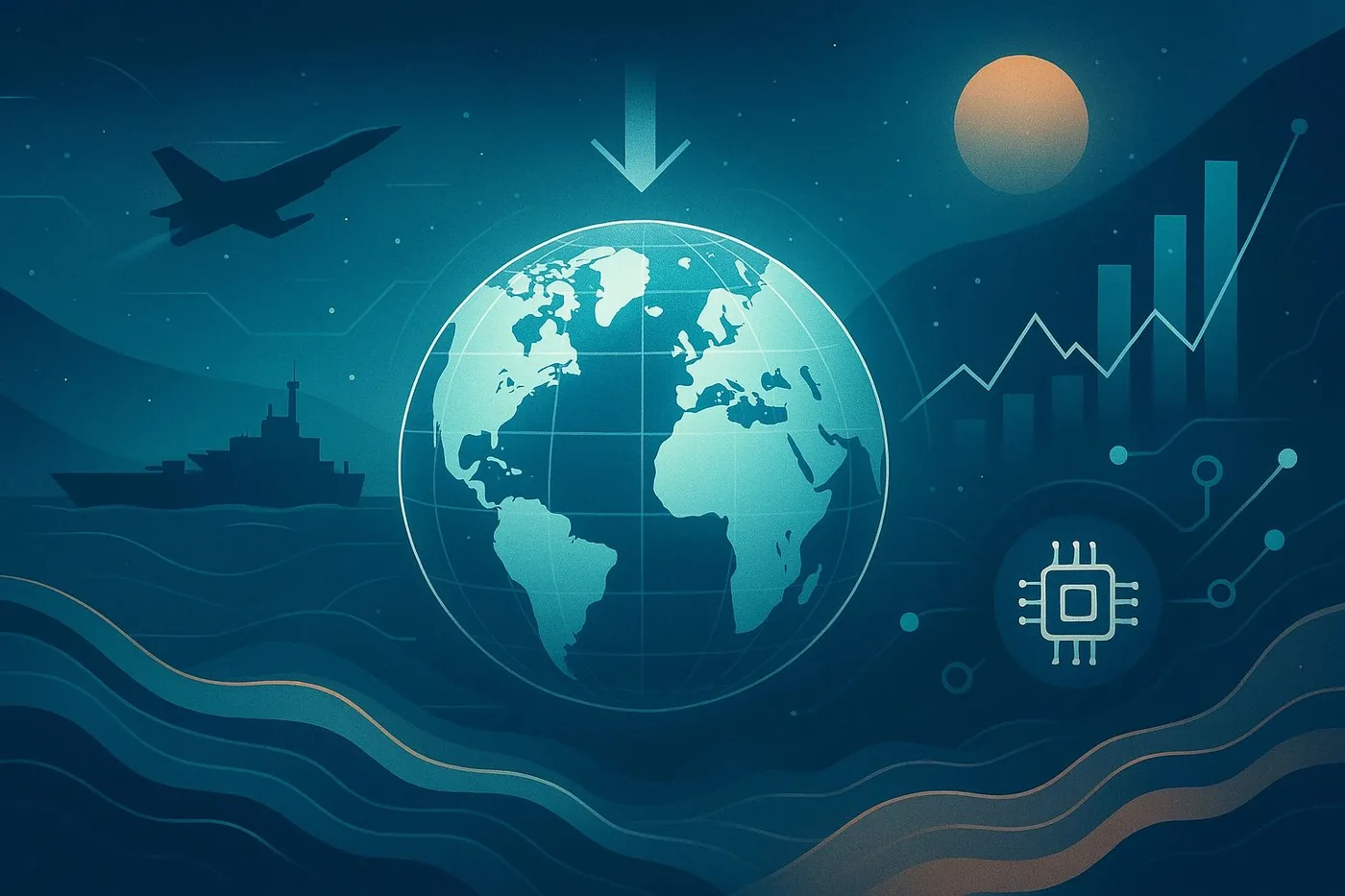
Great‑power rivalry, economic fragmentation, and transnational instability have converged to create one of the most complex geopolitical environments in decades. More than a decade ago, Joseph S. Nye Jr. captured this emerging reality with a line that feels even more accurate today: “The world is neither unipolar, multipolar, nor chaotic—it is all three at the same time.”
That hybrid framing challenges the habit of slotting the world into a single polarity. Instead, it asks us to examine how power behaves across different layers—military, economic, and transnational. Nye wasn’t alone in wrestling with this question. Thinkers like Charles Krauthammer, Samuel P. Huntington, and Richard N. Haass each offered distinct interpretations of the post‑Cold War order.
How do their core ideas relate to the present, and what probabilistic assessment can we draw about where the global system stands in early 2026—and where it may be heading?
Krauthammer’s Unipolar Moment: The High Tide of American Primacy
In 1990/91, Charles Krauthammer argued that the collapse of the Soviet Union created a rare “unipolar moment” in which the United States stood as the world’s sole superpower.
“The immediate post‑Cold War world is not multipolar. It is unipolar. The center of world power is an unchallenged superpower, the United States…”
For Krauthammer, this was both an opportunity and a warning. U.S. military reach, economic scale, and ideological influence were unmatched—but not guaranteed. The 1990s largely validated his thesis, yet he underestimated the speed at which globalization, China’s rise, and technological diffusion would erode unipolarity.
In 2026, U.S. military dominance still resembles Krauthammer’s world. But economically and technologically, the system has moved far beyond a single center of gravity.
Huntington’s Civilizational Multipolarity: Identity as Geopolitics
Samuel P. Huntington shifted the debate from power to identity. In The Clash of Civilizations, he argued that the post‑Cold War world would fracture along cultural lines rather than ideological ones.
“Global politics is both multipolar and multicivilizational… modernization is distinct from Westernization.”
Huntington anticipated the rise of non‑Western powers asserting civilizational narratives—China’s Confucian revival, India’s civilizational state rhetoric, and the Islamic world’s political reassertion.
Critics saw his thesis as overly deterministic, but in 2026, identity‑driven politics—from BRICS expansion to Middle Eastern realignments—echo many of his predictions. Multipolarity today is not just about power; it’s about plural worldviews.
Haass’s Nonpolarity: A World Without a Center
Richard N. Haass introduced a different lens: nonpolarity—a system where power is dispersed among states, corporations, NGOs, militias, and networks.
“The principal characteristic of twenty‑first‑century international relations is… nonpolarity.”
This framework captures the rise of actors that don’t fit neatly into traditional geopolitics:
- tech platforms shaping information flows
- cybercriminal networks disrupting infrastructure
- climate shocks and pandemics overwhelming state capacity
Haass’s world is one of vacuums and volatility. It explains why global governance struggles to respond to AI risks, climate extremes, or pandemics. Yet it underplays the renewed strategic rivalry between major states—especially the U.S. and China.
Nye’s Hybrid Chessboard: Three Systems at Once
Nye’s “three‑dimensional chessboard” integrates the strengths and blind spots of the other models:
- Military: unipolar (U.S. primacy)
- Economic: multipolar (U.S., China, EU, India)
- Transnational: nonpolar/chaotic (cyber, climate, AI, terrorism)
“The world is neither unipolar, multipolar, nor chaotic—it is all three at the same time.”
This hybrid model is arguably the most accurate description of 2026’s geopolitical architecture. It explains why the U.S. can dominate militarily while struggling to shape economic rules or manage transnational threats.
Where We Stand in Early 2026: A Probabilistic Snapshot
By January 2026, the global system has moved decisively away from the post‑Cold War order. Analysts from the World Economic Forum, Eurasia Group, and major think tanks describe a world trending toward “multipolarity without multilateralism.”
Key dynamics shaping the moment:
- U.S. unipolarity continues to erode, accelerated by inward‑focused policies.
- China’s “electrostate” model expands its influence across Asia, Africa, and the Middle East.
- Middle powers—India, Indonesia, Saudi Arabia, Türkiye, Brazil—gain leverage.
- Global institutions weaken as issue‑specific coalitions proliferate.
- AI, cyber volatility, and climate shocks inject nonpolar chaos.
Probabilistic Assessment (2026)
Multipolar Dominance 70%
U.S., China, EU, India, and regional blocs shape trade, tech, and diplomacy.
Bipolar Underpinnings 20%
U.S.–China rivalry forms a structural backbone, especially in tech and security.
Residual Unipolar/Chaotic Mix 10%
U.S. military primacy persists; nonpolar disruptions create instability.
This distribution reflects a world where multipolarity is the center of gravity, but not the whole story.
Looking Ahead: 2030–2035 Scenarios
65% — Deepened Multipolarity / Multiplex Order
A “multi‑speed” world emerges: modular coalitions on AI, climate, supply chains, and security. Middle powers maneuver fluidly. Fragmentation risks rise without strong multilateral institutions.
25% — Bipolar Escalation
If U.S.–China de‑risking fails, tech and trade conflicts could harden into a bipolar system with Europe and Asia as contested arenas.
10% — Unipolar Revival or Nonpolar Breakdown
Low‑probability but high‑impact outcomes:
- A U.S. resurgence if China faces structural economic shocks
- A nonpolar “G‑Zero” collapse if climate or technological crises overwhelm state capacity
These scenarios hinge on elections, technological breakthroughs, demographic shifts, and conflict trajectories.
Conclusion: Navigating a Hybrid, Unsettled Future
From Krauthammer’s unipolar optimism to Haass’s nonpolar pessimism, each framework captures a piece of the puzzle. But Nye’s hybrid model best reflects the world of 2026—a system where multiple polarities coexist and collide.
The next decade will reward countries that can:
- build flexible, issue‑based coalitions
- manage rivalry without severing interdependence
- invest in resilience against transnational shocks
The old order is fading, and the new one is still forming. The only certainty is that the global system will remain hybrid, fluid, and contested.
Disclaimer: The information provided in this blog post is for informational and educational purposes only and does not constitute financial, investment, or professional advice. The content reflects general market commentary and analysis as of January 22,2026, and is subject to change without notice. Neither Vivek Sharma nor anyone affiliated with Gwynedd Wealth Partners, LLC guarantees the accuracy, completeness, or suitability of the information provided.
Investing in securities involves risks, including the potential loss of principal. Past performance is not indicative of future results. Investors should conduct their own research or consult with a qualified financial advisor before making any investment decisions. The mention of specific securities, sectors, or strategies does not constitute a recommendation or endorsement to buy, sell, or hold any investment.
Readers are responsible for their own investment decisions and should consider their individual financial circumstances, risk tolerance, and objectives. For personalized advice, please contact a licensed financial professional.
This blog post may contain forward-looking statements based on current expectations, which are subject to risks and uncertainties that could cause actual results to differ materially. External sources, including web data and posts on X and LinkedIn, have been referenced where applicable, but their accuracy is not guaranteed. Always verify information independently before acting on it.
This article is general information, not personalized advice. Investment advisory services are offered through Gwynedd Wealth Partners, LLC.