
The fog of war and the fog of a bear market have more in common than most people realize. In both arenas, pressure reveals whether a strategy was ever real — or just a plan that felt good when stakes were low. As analysts continue to assess the US-Israel military campaign against Iran, three strategic failures have emerged that carry remarkably direct lessons for investors and anyone who has ever wondered if their money is truly working for them.
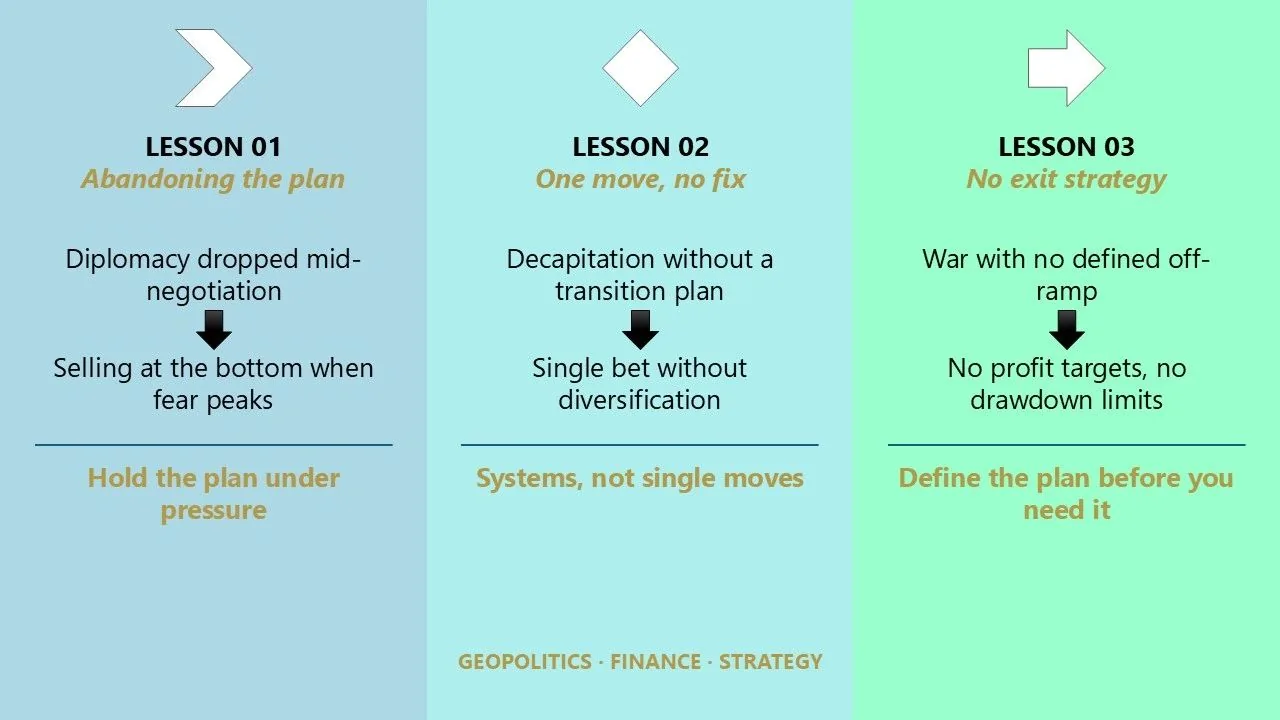
LESSON ONE
Never abandon the plan when the pressure is highest
In the hours before strikes began, Omani mediators reported a near-complete diplomatic agreement — then the bombs fell anyway. The moment discipline was needed most, it was discarded.
In financial terms, this is the investor who builds a sound long-term portfolio, watches markets fall 20%, and then sells everything into cash — locking in losses at the exact moment recovery was beginning. The plan wasn't wrong. The execution was.
A portfolio only performs if you hold it through the conditions it was designed for. Volatility is not a failure of strategy — it is the price of return.
A financial planner's greatest value isn't picking the right fund. It's standing between you and your worst instincts when markets turn ugly. They have seen the panic before, and they know what happens to those who sell — and to those who stay.
LESSON TWO
One decisive move doesn't solve a structural problem
Removing a leader doesn't dismantle a regime built over decades. The institutions, networks, and incentives that sustain it remain intact — and nature abhors a vacuum.
Investors make this mistake constantly. They make one bold move — consolidating into a single high-conviction stock, shifting entirely into real estate, or betting on a single theme like AI or crypto — and expect it to fix everything. It rarely does, and it often makes things worse.
Wealth is built through systems, not strokes of genius. Diversification, tax efficiency, rebalancing, and estate planning working together produce outcomes that no single "big bet" can replicate.
A good financial planner builds architecture, not excitement. They are less interested in the one move that might double your money and far more focused on the interlocking disciplines that compound quietly over decades.
LESSON THREE
Starting is easy. Knowing how it ends is everything.
Military analysts noted a striking absence: the stated objectives shifted week by week. Without a defined end state, there is no off-ramp — only escalation and drift.
This is the investor who enters a position without ever asking: when do I exit? Under what conditions do I take profits? What drawdown triggers a review? When does retirement income begin — and from where? Without those answers, emotion fills the vacuum, and emotion is the most expensive advisor in the room.
A financial plan without an exit strategy isn't a plan. It's a wish. The market will test it, and wishes don't hold up under pressure.
Working with a financial planner forces the conversation you've been avoiding: the one about goals, timelines, and trade-offs. It turns a vague intention into a navigable map — one that tells you exactly what success looks like, and exactly when you've arrived.
Geopolitical strategy and personal finance operate on different scales, but they share the same fundamental truth: the most costly mistakes are rarely made in the planning phase. They happen when pressure arrives and the plan gets thrown out. The discipline to hold, diversify, and know your exit — those aren't instincts. They're skills. And they're exactly what a trusted financial planner helps you build before you need them.

This article is general information, not personalized advice. Investment advisory services are offered through Gwynedd Wealth Partners, LLC.